What You’ll Learn in This Post
- What is the age of the oldest sundial?
- How can sundials inform your knowledge of meteorology?
- How do you convert between time zones?
- How do you account for Daylight Savings Time in time conversions?
- Why are time zone conversions necessary in meteorology?
Introduction
Time was originally kept by tracking the position of the sun in the sky. By the 19th century, inventions such as the telegraph and railroads necessitated the standardization of time for long-distance travel and communication. The adoption of standard time zones took place over the course of several decades after the time they were first proposed. In meteorology, being able to convert between time zones is an important skill because while some observations are made in local time, most are made in reference to Coordinated Universal Time (UTC), based in Greenwich, England. Another term for UTC is Greenwich Mean Time (GMT).
Table of Contents
Early Timekeeping: Sundials
How a Sundial Works
Since we’re on the topic of time, let’s take a moment to consider the original means of timekeeping: the sundial. The sundial consists of a shadow-casting object, known as a gnomon, and a dial with hours marked to keep the time. As the sun appears to move from east to west across the sky (in reality, of course, the Earth is rotating on its axis), the shadow progresses around the dial.
How old is the oldest sundial? (Click for answer)
The oldest known sundial dates to about 1500 BC. The sundial in the photo below is more recent; it was found in the Valley of the Kings in Egypt. Sundials were regularly used as a reference for time as late as the 16th to 17th century, even though clocks and watches were invented during this time. These early timekeeping pieces could be unreliable, so sundials were used as a means of calibrating the clocks and watches. You might be interested in reading about the history of sundials.

A Meteorological Connection
Sundials have some meteorological significance as well. The shadow always marches around the sundial in the same direction. We call that direction, or sense of rotation, clockwise. Meteorologists often look at how the wind direction shifts with increasing height, with interest in whether the wind is changing in a clockwise or counterclockwise sense. We’ll discuss this wind shear[link] in a later post. When tornadoes are wreaking havoc, they can also be rotating in a clockwise or counter-clockwise sense (though counter-clockwise rotation is more common). The time lapse video below shows the clockwise progression of the shadow on a sundial through the day.
Modern timekeeping: Converting between time zones
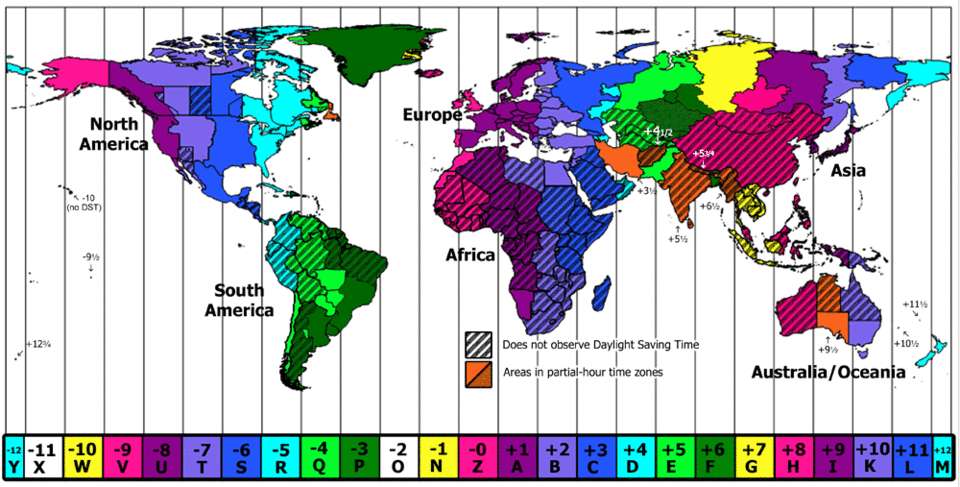
Rather than viewing time from a local perspective, as sundials do, in modern society we often consider time from a global perspective. The map below shows the current time zones around the globe. The reference time zone for Universal Time Coordinate (UTC) runs through Greenwich, England and is indicated by a pinkish or magenta color, with the number “-0 Z” at the bottom of the map to signify that no time change is necessary to compute UTC in this time zone. Here, the “Z” stands for Zulu time – the same as UTC – which is used in the military. Both UTC and Zulu time are expressed in 24-hour time. So, for example. 5:17 pm is written as 1717 (find this by adding 12 hours to 517).
How do you convert between time zones? (Click for answer)
To convert between time zones, it’s necessary to perform two conversions: between 24 hour time and 12 hour time, and from one time zone to the other.
For each time zone on the map below, there is a number representing the offset in hours for that time zone from UTC. For example, standard time in the eastern United States (light blue) has an offset of -5 hours. We can find the local time based on, for example, a UTC time of 12 noon or 1200 hours. The current local time in the eastern US would be 12:00 minus 5:00, giving a local time of 7:00 AM.

The example in response to the question above was a simple example, because no conversion to 12-hour time was necessary. However, if we want to find the local time in the eastern time zone at 1900 UTC, we need to subtract five hours (1400 local time) and then subtract another 12 hours to get 2:00 pm local time. Local time in the U.S. is expressed in 12-hour (am/pm) time, while UTC is in 24-hour time. Anytime the local time is greater than 12:00 pm or 1200 hours, the time is post meridian (pm), as in the sun being past its highest point in the sky. Any additional hours above 12 must be subtracted from the time to find the local am/pm time.

To convert the other way, from a local time to UTC time, use the opposite sign for the conversion. For example, to convert 2:00 PM in US central standard time to UTC, add six hours (because central time is -6 hours from UTC). The corresponding UTC time would be 2000 hrs. or 8:00 PM.
What about Daylight Savings Time? (Click for answer)
From mid-March through early November, most of the U.S. and many other countries around the globe observe Daylight Savings Time (DST). During DST, local time is one hour closer to UTC, because UTC does not observe DST. For example, the conversion from UTC to to DST in the US Eastern Time Zone would involve a four hour time difference, rather than a five hour time difference.
Time zone conversions get even trickier as midnight approaches because the date changes in the time conversion. For example, adding five hours to a local time of 9:00 PM in the standard Eastern time zone would produce a UTC time of 0200 hours on the next date! As another example, a time of 10:37 pm Eastern Standard Time on June 2 would convert to 0337 (3:37 am) on June 3, UTC time. When it is late evening in the eastern US, it is in the wee hours of the next day in England. The quiz at the bottom of the page provides an opportunity to try some of these time conversions for yourself.
Why did the procrastinating time zone never get anything done? (Click for answer)
Because it was always trying to “turn back the clock” instead of moving forward!
Meteorological Applications
Most meteorological observations are reported in UTC time, rather than local time. This includes both the skew-T diagrams introduced in Chapter 1 and the meteograms introduced in Chapter 2. If you collect some weather data, you will likely need to translate from the local time of the observation to UTC time or vice versa. For example, if you take a photo of some clouds at 2:32 PM Eastern Standard Time, and you want to relate it to a meteogram or skew-T diagram at that time, the corresponding time would be 1932, or 7:32 PM.

In the next installment, we’ll apply our knowledge of time zones in looking at a meteogram: a graph of how several different meteorological variables change with time.


You must be logged in to post a comment.