
What You’ll Learn in This Post
- How can we measure humidity with a simple, two-thermometer device?
- What is saturation?
- What’s the difference between dewpoint temperature and relative humidity?
- How was relative humidity measured before the sling psychrometer was developed?
Introduction
We can measure humidity (or water vapor content) in the atmosphere by interacting with it. Humidity measurements are simple “experiments” to determine how much water vapor is in the air!
Table of Contents
Measuring Humidity
A sling psychrometer is a simple device that measures humidity. As you can see below, it consists of two thermometers: a dry-bulb and a wet-bulb. The tip of the wet-bulb thermometer is covered by a cloth sock which is moistened. The psychrometer is spun so that the thermometers rotate around the handle. As it spins, the wet-bulb thermometer will cool in response to the evaporation of moisture from the sock. (Here’s a summary of how phase changes and temperature changes are related.)
The lower the environmental humidity (the farther the air is from saturation), the more the wet-bulb will cool. After the psychrometer is spun for a long enough time, the moisture on the cloth sock equilibrates with the moisture content of the surrounding air, and the web-bulb temperature remains steady.
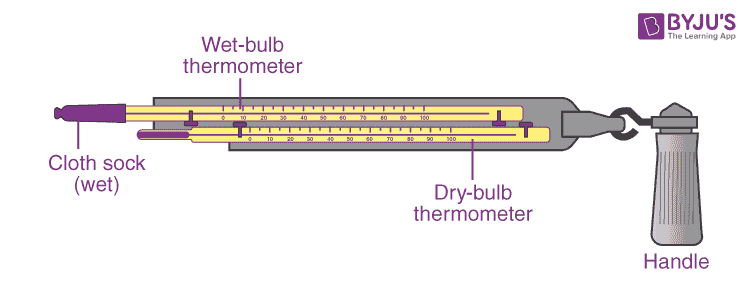
As the wet-bulb cools, the dry-bulb temperature changes minimally while the psychrometer is spun; the dry-bulb indicates the air temperature. The dry-bulb and wet-bulb temperatures are used to compute the relative humidity and the dewpoint temperature. The wet bulb temperature is NOT equal to the dewpoint temperature; rather, a psychrometric chart is used to compute the dewpoint temperature and relative humidity.
Dewpoint temperature indicates the temperature at which saturation occurs given the amount of water vapor in the air. In other words, the dewpoint temperature indicates the temperature to which the air must be cooled for condensation to occur.
What’s saturation again? (Click to expand)
Saturation is the condition that occurs when the condensation rate equals the evaporation rate. The air can also be saturated with respect to ice when deposition occurs at the same rate as sublimation. At saturation, the air has reached its capacity to support additional vapor for the given temperature and pressure. When more vapor is added, individual vapor molecules then condense (water saturation) or deposit (ice saturation) onto hydrometeors, and the hydrometeors grow.
In nature, saturation is not a strict limit on the moisture the air can hold, but the relative humidity (RH) rarely exceeds saturation (100% RH) by more than 1-2%. You might want to review the Water Phase Changes and Recipe for Clouds posts for a brief recap of related concepts.
While the sling psychrometer is useful for measuring the humidity by hand, a more practical device is the hygristor. A hygristor measures the water vapor in the atmosphere by detecting the electrical resistance to moisture by the sensor that detects humidity.
Dewpoint Temperature vs. Relative Humidity
There’s a key difference between the dewpoint temperature and the relative humidity: the dewpoint temperature is an absolute measure of water vapor in the air. That is, when the dewpoint temperature is higher, the air contains more water vapor, and when it’s lower, it contains less.
The relative humidity, on the other hand, indicates the amount of moisture in the air relative to saturation. As the relative humidity is higher, the air is closer to saturation, and as the relative humidity is lower, the air is farther from saturation. What’s “relative” in relative humidity is the amount of saturation. The saturation point changes depending on the temperature and pressure.
When the difference between the air temperature and dewpoint temperature (or between the dry- and wet-bulb temperatures) is large, the relative humidity is low; when the temperature difference is small, the relative humidity is high. Relative humidity can be somewhat deceptive because it can be high when there is less water vapor in the air IF the air temperature is relatively cold but close to saturation. In other words, the relative humidity can be high on cooler days that we may not perceive as particularly humid.
As a result, the dewpoint temperature is a better indicator of how “muggy” the air is in the summer because it increases as the amount of water vapor in the air increases.
How was relative humidity measured before the sling psychrometer was developed? (Click to expand)
We all know how humid days can produce frizzy hair. Early instruments to measure humidity took advantage of this. The hair hygrometer (shown below) stretches human or horse hairs to indicate the relative humidity. This device is simple enough that you can build one of your own.
![[Hair hygrometer]](https://understandingtheweather.org/wp-content/uploads/2024/03/image.jpeg)
Summary
The slide below summarizes some of the key ideas from this post. A key point to remember is that the dewpoint temperature indicates how much water vapor is in the air, while the relative humidity indicates how close the air is to saturation. Remember, especially on a humid summer day, the dewpoint temperature is a better indicator than relative humidity as to how muggy the air is!


In the next installment, we’ll return to the topic of cloud formation and detail how rising air causes clouds to form.


You must be logged in to post a comment.