
Phase Changes and the Environment
We’ve been focusing on evaporation and condensation, but there are four other phase changes of water. The image below shows all of the net phase changes of water. You’re probably familiar with melting and freezing, but you may not be aware that water can go straight from ice to vapor (“sublimation”) or from vapor straight to ice (“deposition”).
There’s a short practice quiz below to test your knowledge of these phase change terms. If you get stuck, try looking at the figure below. (Note: any time we refer to phase changes, we mean net phase changes.)

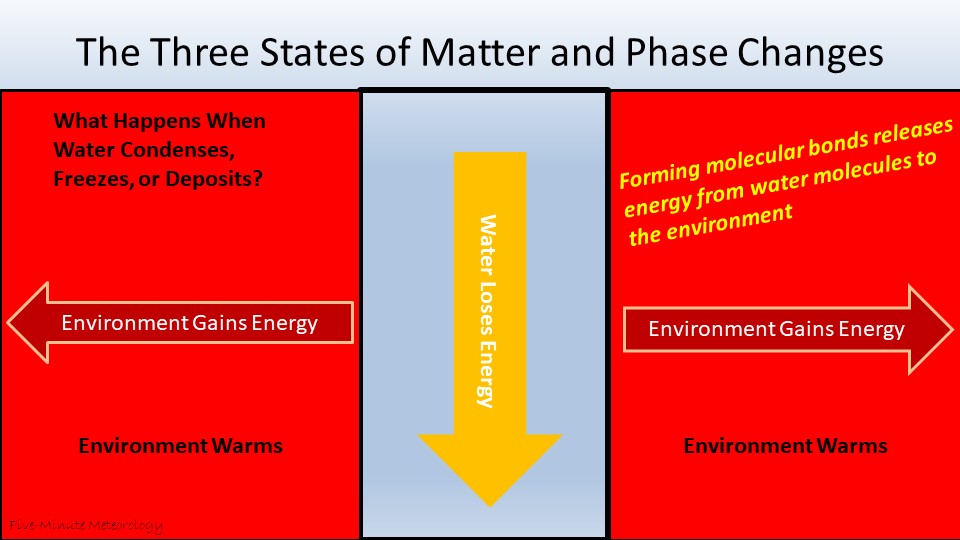
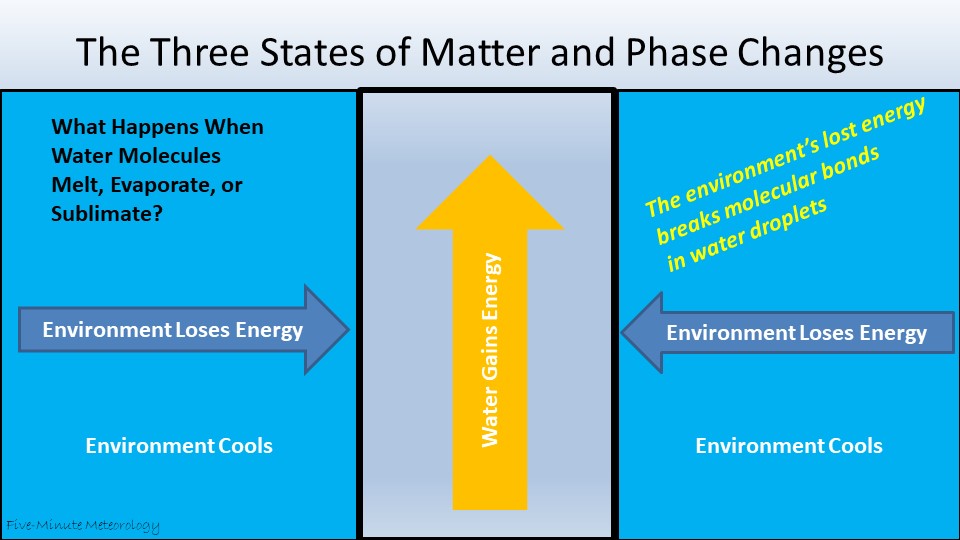
The image below also summarizes the internal energy changes associated with each phase change, using arrows. For the three phase changes on the left (evaporation, sublimation, and melting), the kinetic energy of the water molecules increases. For those on the right (freezing, condensation, and deposition), the water molecules’ kinetic energy decreases.

It is a yin/yang process: if the water molecules lose kinetic energy, the environment gains thermal energy; if the water molecules gain kinetic energy, the environment loses thermal energy. This a fundamental principle of meteorology.
How does water gain the kinetic energy it needs to move from a lower energy state to a higher one? (Click for answer)
In order for water to make the jump from a lower state of energy to a higher one, there must be an exchange of energy between the water molecules and the surrounding environment. The energy gained by the water (warming) must be lost from the environment (as cooling) to fuel the water’s phase change. On the other side of the coin, when water molecules lose energy in a phase change, they release that energy in the form of heat energy to the environment.
This energy exchange during phase changes involves the making or breaking of bonds between water molecules, which changes the temperature of the surrounding air in the process.
On the next page, we’ll apply these concepts to some real-world examples. Please advance to the next page using the links below.


You must be logged in to post a comment.